

Everyone Means Everyone
Belle Burden's book Strangers made me think of whose experiences matter in public spaces.

Before getting into the theme of this post, a short plug: I share the Metropolitan Libraries Section of the International Federation of Library Associations and Institutions. Our section’s goal is to create opportunities for learning and exchange for library professionals in major cities. Here are a few:
Apply to join the MetLib Learning Circle, a global, free-of-charge, 12-month networking and leadership program for library leaders. Applications are due 22 March. Read more here.
Submit a proposal to speak about your work at the Metropolitan Libraries conference in Utrecht, The Netherlands, 25-28 October. Proposals are due 1 April. Read more here.
Have you build a great library and want it to be recognized? Submit a proposal for the IFLA/James Bennett Public Library of the Year Award. Applications are due 20 May. Read more here.
OK, on with the show.
“It was a great love story, one for the ages. The speed of our beginning and the speed of our ending felt like matching bookends. They both came out of nowhere. He wanted it, he wanted me. And then he didn’t.”
Belle Burden: Strangers
Belle Burden’s much buzzed memoir Strangers on the unexpected collapse of her storybook marriage is one of the most moving books I have read this year. Burden belongs to a New York family of great economic, social and cultural capital. Burden’s grandmother was the editor of Vogue, her father was owned Village Voice and her mother was well-known socialite and later the Planning Director for New York City,
But as the world was coming to terms with the fear of what turned into years of the COVID-19 pandemic, she experienced her husband walking out of her life without explanation, expressing no interest in custody of their three children. As her life falls apart, Burden is trying to keep a brave face for her children and understand what happened. On her life on the island, taking long walks and taking children to hobbies, she witnesses how the scandal makes some people lean in and others take distance.
The novel’s strength is its honesty. Burden does not attempt to hide the fact that she comes from privilege and that her COVID isolation was in a large house on the summer resort of the affluent in Massachusetts called Martha’s Vineyard. She has friends and family who care for her, check in on her and support her.
But even with all these resources, her pain and loss are real and deep. Like any skilled memoir writer, she does not spare herself as she tries to understand what might have led to this and as she starts putting the puzzle of her life together again. She shows herself needy, lonely and sorry for herself. She unsparingly describes her financial choices, taken against legal and family advice during her marriage, which come to cost her a great deal in the breakup of her marriage.
While the book has received great praise, there has also been vocal critique or even mockery, which could be summarized “boo hoo, poor little rich girl”. While I understand some of the calls for more diverse voices in literature that fuel this critique, making cruel fun of someone’s suffering is never the right strategy for social justice.
As an avid reader, I also think that the questions of relatability and importance of stories are more complex than whether someone’s life is similar to mine. One of the real powers of literature is how an emotion or a moment of someone vastly different from us can punch us in the stomach with a surprising force or offer us solace and comfort. The power of stories is reminding us how all of us are more complex and messy than others think, that we have more identities than others see, how we all seek to be seen as full persons and how most of us struggle with emotions and insecurities we want no witnesses for.
Please See Me
A few weeks back I was doing some public engagement at a branch library in a large American city. As we were ready to pack up, an older Black man approached me. His eyes were kind and curious. As he rolled his oxygen tank over, he encouraged his wife to go upstairs to do “her things” while “I talk to this young man”.
We sat down. Before I got our survey going, he had asked several questions about my work, educational background and our approach in the project. It became apparent to me that none of the identities that I could assume by looking at him were there ones he wanted to be seen through. He wanted to tell a story of someone with a scientific career, with skills and knowledge and with a new curiosity for learning. As we discussed his library use, he opened up about loneliness and his recovery after hospitalization. His way of showing up, asking questions from me and telling me of his life, will stay with me forever.
When I think of this exchange and my hours spent with Burden’s story (I listened to the book read by her), I wonder if our times have a risk of turning system-level aspirations for fairer distribution of resources into selective and at times condescending compassion for human self-determination and suffering. Both the man I met and Burden in the midst of her crisis had genuine needs for connection and belonging and hardships they had to come to terms with. For one of them the needs were apparent while the interests required exploration and curiosity. For the other, the needs were hidden while we were able to witness a life of extreme privilege. What I think does unite them is the need to be met with dignity. The older gentleman was not a member of a vulnerable group but a scientist. Burden was not a “poor little rich girl” but a wife and a mother whose life had fallen apart.
Is Everyone Everyone?
Over the last months I have been having numerous conversations with library staff and leaders on how they position their institution in the times we live in. As a tool for thinking and maybe slightly for provocation, I have used the 2x2 grid below. (I wrote a longer piece on it here.)
Basically I ask two questions: do you focus on relationships or services and do you strive to reach the most vulnerable or everyone? Is your key metric of success that everyone uses the library or that those with greatest need get the help they need? These questions create four possible library profiles: Place of Growth and Wonder, Civic Center, Support Hub and Liberator.
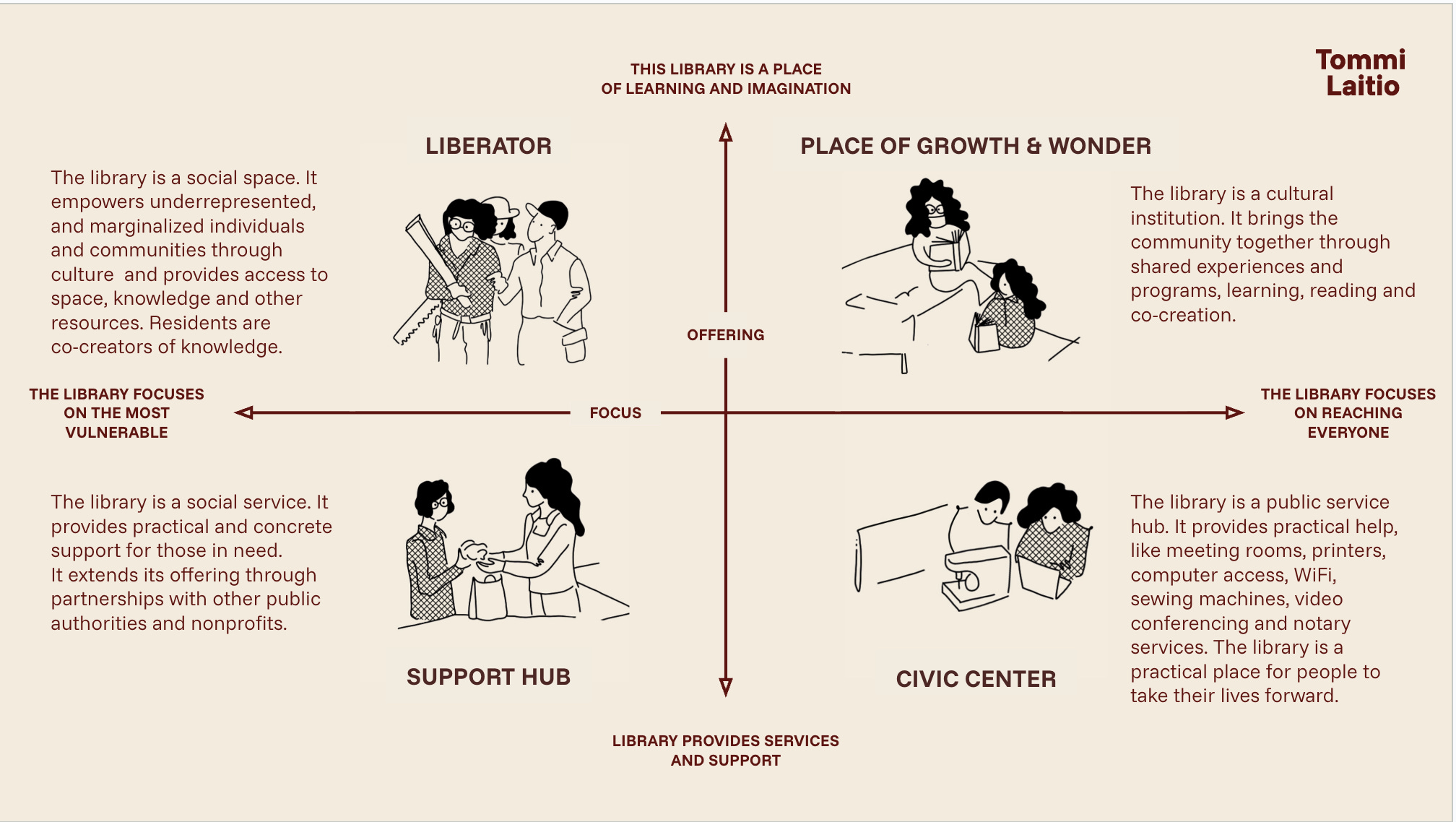
Most people I have discussed this with react by saying that of course they do this all. But when you actually look at their strategy, their key indicators and their development resources, it is clear that libraries are choosing different paths.
During my talks I have had people vote where they think their institution currently is and where they think it would need to be. While there is some variation, many feel that the library is not positioned in the way it should. Simply put: libraries feel pulled to the lower half (filling up the space left for social services or providing transactional spaces and tools) while they would want to be in the top right corner (promoting and supporting learning and connection).
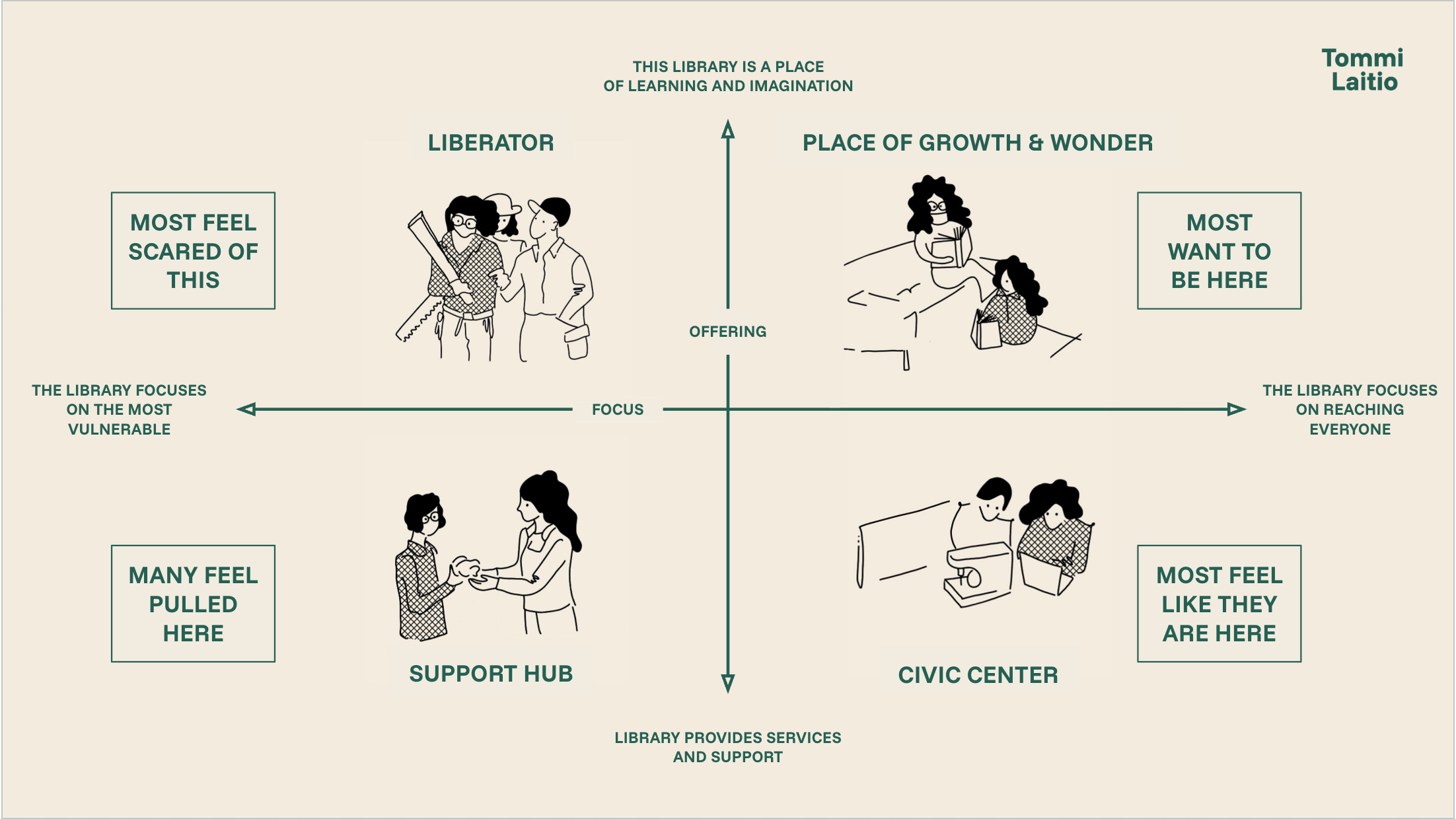
These choices are of course always contextual. It is understandable that in moments of crisis (say: pandemic, heat wave, hurricen or homelessness), it is important for a civic institution to show responsiveness and demonstrate its role in helping the most vulnerable. But it is honest to recognize that these staff-intensive services as permanent modus operandi limit the institution’s ability to do other things and they do end up limiting people’s perception of your institution.
The lower right corner (civic center) is where many say they are. Being a civic center feels safer in politically divisive times of vitriolic politics and book bans and there are existing practices for leading and evaluation customer service from the private sector.
But the more I think about the potential of libraries on weaving our cities - and sometimes even us as individuals - together, I see a need to amplify the library as a place of stories and learning. We have no other institutions that are grounded in stories, that have such wide support and that act from such a place of extreme generosity.
I do think the great potential for libraries is being a place where everyone, both people like Burden and the scientist I met, it met as a responsible person with individual interests and needs. To demonstrate a real commitment to equity, this approach can be combined with a transparent way to direct more resources to those communities with greater need. At its best, in times when so many of us are lost and lonely, the library can be a place where we can all feel like we are connected to the city we live in and where we can explore our own stories and those of others. Like the British philosopher Isaiah Berlin so beautifully put it:
“I wish to be a subject, not an object…I wish to be a somebody, not nobody; a doer - deciding, not being decided for, self-directed and not acted on by the external nature or by other men as if I were a thing, or an animal, or slave incapable of playing a human role, that is, of conceiving goals and policies of my own and realizing them.”